WhatsApp
Material properties are a crucial factor affecting the screening efficiency of vibrating screens. Among them, the four main factors are material moisture content, material type, material particle size, and material bulk density.
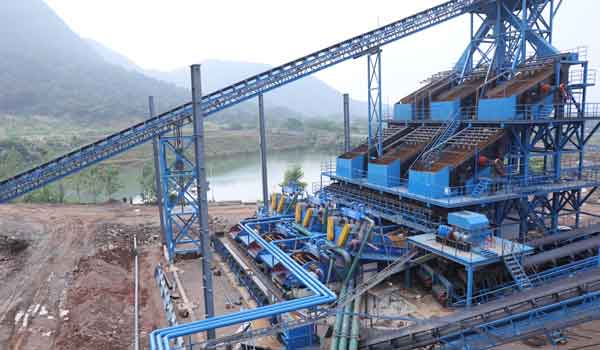
What material properties affect the screening efficiency of a vibrating screen?
1. Moisture content of materials
If the material has a high moisture content, it is easy for it to stick together, which reduces the screening efficiency. During vibration, the blocks are squeezed together and become densely packed, which increases the resistance to material movement and makes it difficult for the material to pass through the screen. Material sticking together will reduce the size of the screen openings, decrease the screening area, and make it impossible to screen materials with high moisture content.
2. Material type
Materials can be classified into brittle and sticky materials. Sticky materials are prone to clogging the screen during the screening process, which reduces the screening rate. The particle shape of the material also affects its screening efficiency. Cubic and spherical materials pass through the screen easily, while flaky or irregular materials are more likely to get stuck in the screen holes, thus affecting process efficiency.
3. Material particle size
The ratio of material particle size to sieve aperture size is called relative particle size. The smaller the relative particle size, the higher the probability of passing through the sieve. Materials with a relative particle size of 0.7-1 are generally considered difficult-to-screen materials. The higher the content of difficult-to-screen materials in the material, the lower the probability of passing through the sieve, and the lower the screening efficiency. In order to obtain good screening efficiency, the content of concentrated difficult-to-screen materials should be minimized.
4. Material density
The density of a material directly affects the processing capacity of a vibrating screen. Loose, lumpy materials with higher bulk density pass through the screen more easily, resulting in higher screening efficiency. Conversely, materials with lower bulk density and powdery materials are less likely to pass through the screen, leading to lower screening efficiency.
Related Products
There are no relevant articles.
Send us a message
We will provide you with the most professional services.