WhatsApp
A chamber filter press mainly consists of a pressing plate, a thrust plate, a filter medium, filter plates and filter frames, a crossbeam, a pressing device, and a liquid collection tank.
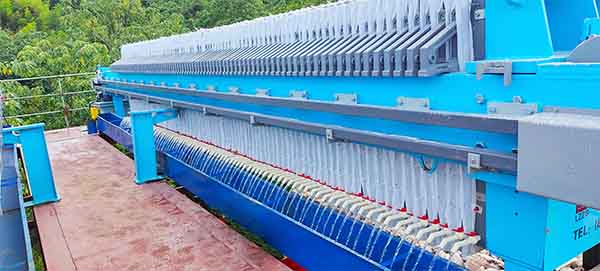
How does a chamber filter press work?
A chamber filter press consists of a set of filter chambers made up of alternately arranged filter plates and filter frames. The surface of the filter plate has a grooved structure, and the protruding parts are used to support the filter cloth. Each of the filter frame and filter plate has through holes at its corners, which, when assembled, can form a complete channel that allows washing water, suspension, and filtrate to pass through. Each side of the plate and frame has handles that support the top of the crossbeam, and the plate and frame are pressed together by a clamping device. The filter cloth between the plate and the frame acts as a sealing gasket. The feed pump forces the suspension into the filter chamber, where it forms filter cake on the filter cloth until the filter chamber is full.
Chamber filter presses are suitable for suspensions with highly compressible or nearly incompressible filter cakes. The suitable concentration of solid particles in a suspension is generally below 10%, and the operating pressure is generally 0.3~0.6 MPa, but can reach 3 MPa or higher in special cases. The filtration area can be increased or decreased depending on the number of filter plates and frames used. The filter plates and frames are typically square, with a filtration area ranging from 1 to 1200 square meters. The plates and frames are tightened together using manual, electric, or hydraulic methods. The plates and frames are made from materials such as wood, cast iron, cast steel, stainless steel, polypropylene, and rubber.
Chamber filter presses are suitable for suspensions with highly compressible or nearly incompressible filter cakes. The suitable suspension typically has a solid particle concentration below 10%, and the operating pressure is generally 0.3–0.6 MPa, with some special cases reaching 3 MPa or higher. The filtration area can be increased or decreased depending on the number of plates and frames used. The plates and frames are usually square, with an inner side length of 320–2000 mm, a frame thickness of 16–80 mm, and a filtration area of 1–1200 m². The plates and frames are pressed together using manual screws, electric screws, or hydraulic pressure.
Send us a message
We will provide you with the most professional services.