WhatsApp
The spiral chute utilizes water flowing along an inclined plane for mineral processing. Mineral particles of different densities were separated in the tank. The particle size and shape of the mineral particles also affected the accuracy of the separation.
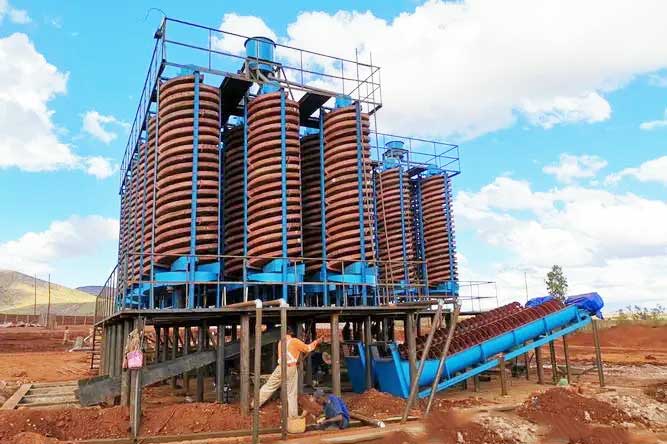
Inside the spiral chute, mineral particles of different densities stratify under the influence of the water flow, the gravity (or centrifugal force) of the mineral particles, and the friction between the mineral particles and the bottom of the chute. Denser mineral particles are concentrated in the lower layer and move forward at a lower speed along the bottom of the tank. They are either discharged from the tank while being fed or remain at the bottom of the tank. After a period of time, the water is intermittently discharged from the tank. The less dense mineral particles are distributed in the upper layer and are carried away by the water flow at a higher speed.
Based on the different chute structures and the different sorting objects, they are divided into coarse-grain chutes and fine-grain chutes.
Coarse-grained sluices are typically narrow, long, sloping troughs welded from wood or steel plates. The bottom of the trough is fitted with baffles or a rough lining. The water layer in the trough is 10-100 mm or more thick, and the water flow velocity is relatively fast. The feed particle size ranges from several millimeters to tens of millimeters. Coarse-grained sluices are mainly used for separating placer gold, platinum, tin, and other rare metal placer ores. Currently, except for gold beneficiation, they have been largely replaced by jigs.
Fine-particle chutes are generally short and do not have baffles at the bottom. In a few cases, rough textiles or gridded rubber sheets are laid on them. In most cases, sorting is carried out directly on wooden, plastic, or cement surfaces. The water in the tank is shallow, ranging from a few millimeters to about 1 mm in size. The slurry flows at a very low velocity, passing over the equipment surface in a thin layer, a process known as film beneficiation. It is an effective method for processing fine and micro-fine particles of ore and is now widely used.
Related Products
There are no relevant articles.
Send us a message
We will provide you with the most professional services.