WhatsApp
Tailings feature high moisture content and contain certain harmful substances. The traditional wet tailings pond discharge method requires large land occupation, easily causes environmental pollution, and carries potential safety hazards.
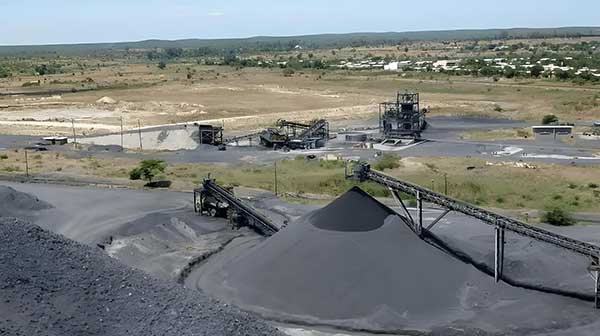
At present, tailings thickening and dry discharge is the mainstream treatment technology. Below are 5 widely adopted tailings thickening and treatment equipments:
1. Hydrocyclone
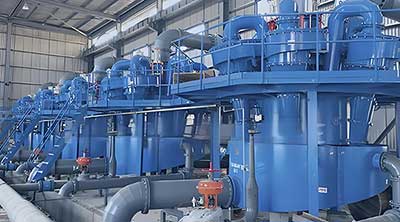
A hydrocyclone consists of an upper cylindrical section and a lower conical section. Slurry enters the cylinder tangentially at a velocity of 5–12 m/s to form a swirling flow, generating centrifugal force far greater than gravity. Coarse particles are thrown toward the cylinder wall and discharged from the underflow spigot along a spiral path; fine particles and most water flow out through the top overflow outlet with the inner vortex.
Thickening and dewatering hydrocyclones are equipped with siphon and fish-tail devices. Operators can adjust the negative pressure inside the chamber via valves to flexibly control underflow concentration, with an adjustable range of 60% to 80%.
2. Thickener
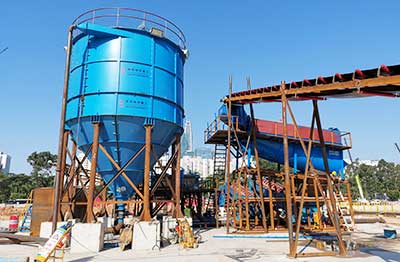
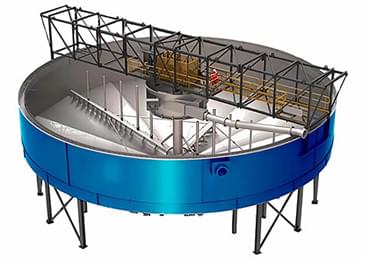
Also known as a concentration tank, a thickener is composed of a thickening tank, rake frame, driving unit, lifting mechanism, central feeding device and other components. Its core advantage lies in large single-unit processing capacity. During operation, flocculants are added to slurry to aggregate fine mineral particles into large flocs, accelerating sedimentation and improving thickening efficiency.
LZZG high efficiency deep cone thickeners adopt a deep cone structure. Inclined plates and degassing tanks are installed in the sedimentation zone, paired with optimally designed overflow weirs to prevent local suction and turbid overflow, delivering more uniform and stable effluent.
3. Dewatering Screen
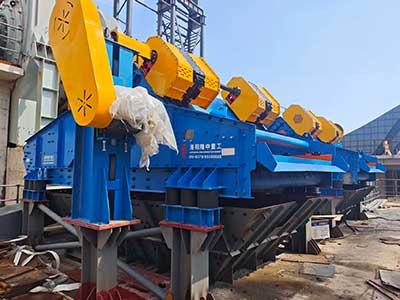
High-frequency vibrating dewatering screens are the typical model, specializing in dewatering and classification of coarse-grained materials. They serve as core equipment for dry material recovery in tailings dry discharge systems.
The screen deck at the feeding section of high-efficiency multi-frequency dewatering screens is inclined. After slurry flows in, a paste-like material layer forms rapidly and moves forward gradually under multi-frequency vibration. Multi-frequency vibration helps build a filter layer, speeds up water penetration and pushes filter cake forward. The screen deck tilts slightly upward toward the discharge end to further reduce the moisture content of filter cake.
4. Filter Press
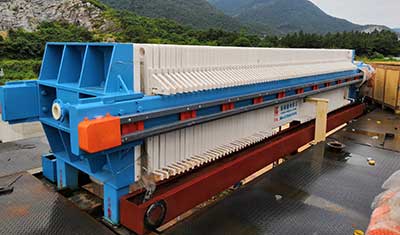
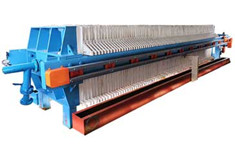
A filter press is made up of main beams, head plates, tail plates, filter plates, hydraulic systems, transmission mechanisms, electrical control systems, pipelines and other parts. It focuses on deep dewatering of fine-grained tailings to produce stackable dry tailings.
Common industrial models include plate-and-frame filter presses, chamber filter presses and fully automatic vertical filter presses. With pressure applied by hydraulic systems, forced solid-liquid separation of filter cake is realized for thorough dewatering. The resulting low-moisture filter cake is convenient for dry stacking, transportation and subsequent resource utilization, making filter presses mainstream terminal dewatering equipment for fine tailings.
5. Sedimentation Tank
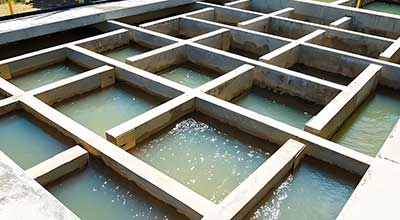
Horizontal flow structures are mostly adopted, and multiple tanks are often connected in series. Thickening and clear water separation rely entirely on natural gravitational sedimentation of tailings particles. Adding flocculants accelerates particle settling. Extending material static airing time can further raise underflow concentration.
Sedimentation tanks boast simple operation and maintenance as well as low upfront investment. However, they suffer from long sedimentation cycles, low overall throughput and limited production efficiency, only suitable for small-scale mines with low output.
Related Products
Send us a message
We will provide you with the most professional services.