WhatsApp
The content of stone powder in manufactured sand is an important factor affecting the quality and yield of manufactured sand products.
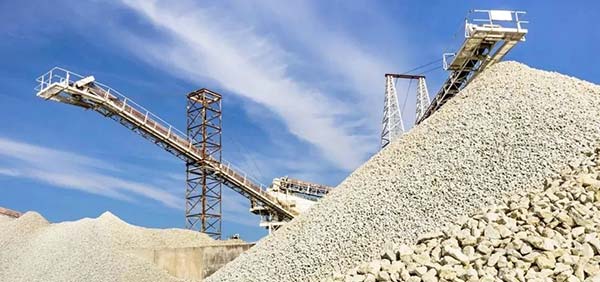
4 Existing Forms of Stone Powder
Free Powder: Stone powder particles do not adhere to each other and do not adsorb onto the surface of sand particles, and can move freely under the action of wind and gravity.
Agglomeration Powder: Stone powder particles tightly aggregate together to form larger particle size stone powder clusters, and the particles adhere and aggregate with each other. This type of aggregate of stone powder is difficult to remove using traditional powder selection equipment due to its large particle size and mass.
Attached Powder: Stone powder particles adhere to the surface of larger sand particles. When the surface of the sand particles is relatively smooth, the stone powder particles are easy to remove under mechanical force. However, when the surface of the sand particles is uneven, the stone powder particles adhere tightly to the sand particles, and it is difficult to separate them by general mechanical methods.
Interstitial Powder: There are often natural or mechanically microcracks on the surface of sand particles, ranging from tens to hundreds of micrometers wide, which are often filled with a large amount of stone powder particles. This is the most compact way of stone powder adhesion.
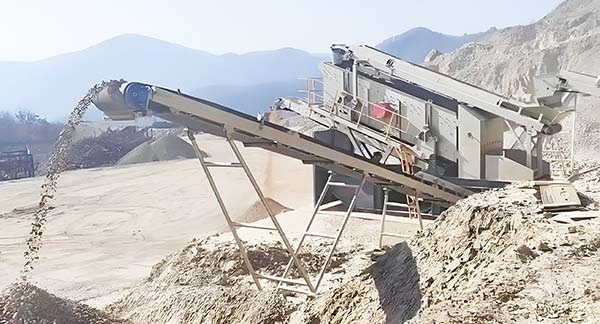
How to Reduce Stone Powder in Manufactured Sand
6 types of technologies and equipment for reducing stone powder are listed as follows:
1. Vibrating Grizzly Screen
Higher mud content in manufactured sand will increase water demand, impair concrete strength and exert adverse impacts on its compressive resistance. Therefore, raw materials shall pass through desliming screening for waste removal before entering the sand-making process, which can also greatly cut down the moisture content of raw materials.
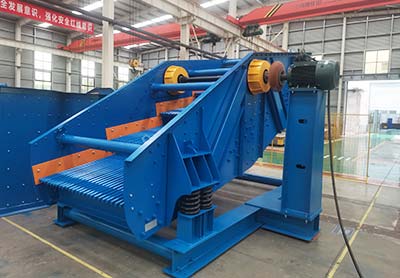
Select appropriate bar spacing according to different material conditions to achieve target desliming performance. For working conditions featuring thick overburden, hard-to-remove vegetation, severely weathered rock mass and muddy interlayers prone to mud contamination, widening the bar spacing can effectively lower mud content.
2. Aggregate Chute De-dusting Unit
Aggregate of a specific size falls into the aggregate discharge chute after screening. An integral detachable air distribution chamber is installed at a proper position and connected to an air blower. As free dust on aggregate surfaces passes through the chute, it is blown up by the blower and sucked into a dust collector for centralized collection.
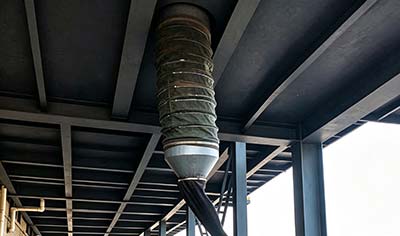
In addition, the air suction volume of the dust collector can be adjusted via pipeline regulating valves. When the blower is equipped with variable frequency drive, the matching ratio of blowing air and suction air can be controlled through variable frequency adjustment of the blower and regulating valves, enabling continuous control over the stone fines content of finished sand and aggregate within a certain range.
3. High-frequency Vibrating Screen
High-frequency vibration is adopted for pre-treatment of manufactured sand to disperse fine powder agglomerates, separate fines from sand and classify coarse and fine fractions, followed by air separation to remove stone fines.
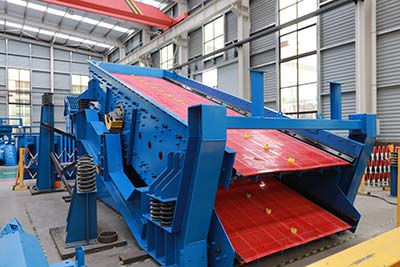
After being crushed by the sand maker, materials are dispersed by a material spreader or spiral feeding rod before entering the screening module, which delivers preliminary dispersion of agglomerated and adhered stone fines and improves material distribution uniformity. Air separation equipment conducts primary classification of stone fines afterwards. The pre-classified materials then flow into the high-frequency vibrating screen with vibration frequency of 60–80 Hz and amplitude of 0.15–2.4 mm for screening.
The vibration intensity of high-frequency vibrating screen is 3.5-5 times that of ordinary one, which can generate a large mechanical force and has good dispersion and separation effects on aggregated stone powder and surface adhesive stone powder. Compared with ordinary vibrating screens, the powder removal efficiency of mechanism sand is significantly improved by about 40% after being screened by high-frequency vibrating screens, and the required air volume is reduced by 45%.
4. Centrifugal Air Classifier
Air classifiers are applied in sand production lines. Air mixes with stone powder to form gas-solid two-phase flow. The rotating material distributor and high-speed airflow generate centrifugal force on the powder-laden air stream as it circulates. Particles of different sizes bear different centrifugal forces, which separates coarse powder from fine powder. Afterwards, coarse and fine fractions are collected separately. Valuable coarse particles become finished manufactured sand, while unwanted ultra-fine powder is discarded.
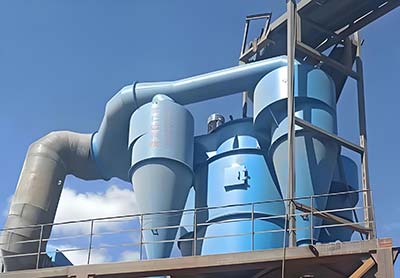
This classifier has strict limits on feed moisture content. If the moisture of incoming material exceeds 5%, its powder removal efficiency will drop drastically. It delivers optimal performance at a feed moisture of 2%, with a sand yield rate ranging from 60% to 70%.
5. Dynamic Air Classifier
Raw materials enter the sand maker and go through vibrating screening; coarse powder returns to the sand maker, while fine powder is conveyed to the combined classifier consisting of a V-type static classifier and a dynamic high-efficiency air classifier.
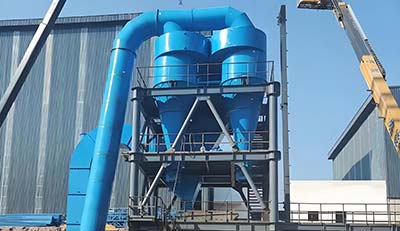
Materials are homogenized by a material distributor before entering the classification system. Coarse particles flow into finished product silos, while ultra-fine particles and micro-powder travel with airflow into the dynamic classifier. Adjusting the rotating speed of the dynamic classifier controls sand classification; qualified products are discharged through the coarse powder pipe and delivered to finished product silos.
The particle gradation of finished products can be regulated. Micro-powder is captured by cyclone dust collectors and stored in stone powder silos, and airflow circulates back to the air inlet of the V-type classifier via a circulating fan.
6. Air Screen
Integrating air separation technology on the basis of vibrating screening, air screens integrate 3 functions: particle size adjustment, classification and screening.
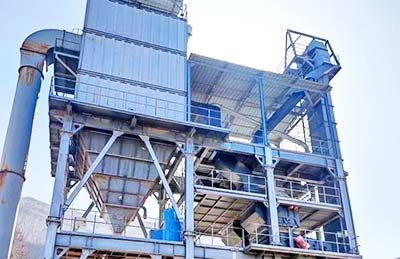
Working principle: Materials are evenly spread by the dispersing unit of the air screen and blown to different zones inside the air separation chamber by an air blower. Lighter materials with smaller particle sizes are blown farther for longer screening distance. The lightest stone fines are blown to the powder outlet, extracted by the dust collector induced draft fan and finally stored in powder silos.
Meanwhile, a particle size adjusting plate automatically modulates the proportion of returned materials to fine-tune the fineness modulus of finished sand and guarantee stable fineness modulus of final products.
Related Products
Send us a message
We will provide you with the most professional services.